
Common Types of Structural Steel Used in Australia
Home » Common Types of Structural Steel Used in Australia
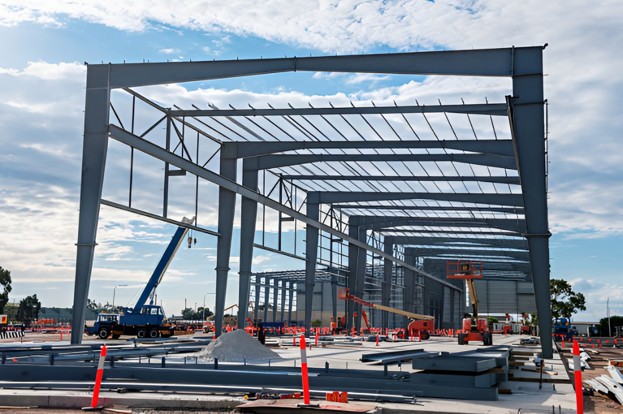
Structural steel is not one product, it is a whole family of sections and grades, each doing a different job within a building. At Steelrise Australia, we fabricate most of these types every week, and understanding what each one actually does makes for far better conversations with your engineer.
Table of Contents
ToggleKey Takeaways
- Universal beams and columns carry most structural loads in buildings.
- Parallel flange channels and angles handle lighter framing and lintels.
- Hollow sections offer excellent strength with a lighter, cleaner profile.
- Grade 300 remains Australia’s default structural steel specification.
- Plate steel and higher grades cover more specialised, heavy duty roles.
Universal Beams and Universal Columns: The Workhorses
Universal beams, or UBs, and universal columns, or UCs, are the sections most people picture when they think of structural steel. Both have an I shaped cross section, but UBs are optimised to carry horizontal loads across a span, while UCs are built with a more balanced profile to carry vertical, axial loads down through a structure.
Parallel Flange Channels and Angles
Parallel flange channels, known as PFCs, are C shaped sections commonly used for lintels above openings, roof trusses and general framing where a full universal section would be overkill. Angles, whether equal or unequal, are the L shaped sections that quietly do a lot of the less glamorous work in a structure, from bracing to support brackets. These sections, along with UBs and UCs, are manufactured to Standards Australia’s AS/NZS 3679.1 specification, which sets out the chemical composition, mechanical properties and tolerances every hot rolled section must meet before it reaches a fabrication shop.
Hollow Sections: RHS, SHS and CHS
Rectangular, square and circular hollow sections, commonly shortened to RHS, SHS and CHS, are increasingly popular for columns, bracing and architectural applications where a clean, uniform profile matters. Hollow sections resist torsion well and often look more refined when left exposed. Research on high strength hollow steel members tested ultra high strength circular hollow sections against standard Grade 300 and Grade 750 steel, showing just how much performance headroom exists above the sections most projects actually specify.
Steel Grades: 300, 350 and Beyond
Section shape is only half the story, since the steel grade determines how much load a given shape can actually carry. Grade 300 remains the default across Australia for most hot rolled sections, offering a dependable balance of strength, weldability and cost. Grade 350 steps up yield strength for heavier columns and welded connections, while higher grades exist for genuinely specialised applications. Paying attention to grade selection early in a project avoids costly redesign later.
Plate Steel and Specialised Applications
Not every structural need fits neatly into a rolled section. Plate steel, cut and welded into custom shapes, covers everything from heavy baseplates to bespoke connections that off the shelf sections cannot achieve. University of Wollongong research into Australia’s new Advanced Steel Manufacturing Precinct highlights how plate steel production at Port Kembla now extends to specialised products for armoured vehicles, naval vessels and wind turbine towers, a reminder that structural steel covers a far broader range than beams and columns alone.
Choosing the Right Section for the Job
Engineers rarely choose a section in isolation. Span length, load type, headroom constraints and even future flexibility all play into the decision. A few practical patterns show up again and again on real projects:
- Long floor spans typically favour deeper universal beams over channels.
- Exposed architectural columns often lean towards hollow sections for a cleaner look.
- Lintels above openings are almost always PFCs or angles rather than full UBs.
- Heavy plant support or baseplates usually call for custom plate steel work.
None of these rules are absolute, and a good structural engineer will always weigh up the specific project rather than defaulting to habit. That said, understanding the general pattern helps when reading drawings or discussing options with your fabricator.
Where Australian Steel Actually Comes From
Most structural steel used on Australian projects still traces back to local mills, and where it comes from is shifting fast. The Australian Renewable Energy Agency’s work on decarbonising Port Kembla Steelworks outlines how the country’s largest steel producer is working to cut emissions from the steelmaking process itself. The Fifth Estate’s coverage of the University of Wollongong and BlueScope partnership adds useful context on just how significant steelmaking emissions are globally. At the same time, Manufacturers’ Monthly’s reporting on imported fabricated steel raises real concerns about compliance when offshore steel enters Australian projects without proper certification, which is exactly why sourcing and traceability matter as much as the section itself. Our services at Steelrise Australia explains how we manage sourcing and compliance on every project we fabricate.
Conclusion
Choosing the right section and grade shapes both cost and performance long before a single beam is lifted into place. If your project needs expert guidance, get in touch with us and our team will help you specify, fabricate and install exactly what your structure needs.
FAQs:
What is the difference between a UB and a UC?
Universal Beams (UBs) are designed for horizontal, load-bearing spans, while Universal Columns (UCs) are intended to carry vertical, axial loads as columns.
What is the most common structural steel grade in Australia?
Grade 300 is the standard specification and is used for the vast majority of hot rolled structural steel sections in Australia.
When would you use a hollow section instead of a UB?
Hollow sections are commonly used for columns, bracing and architectural applications where a clean appearance and greater torsional resistance are important.
What standard governs Australian structural steel sections?
AS/NZS 3679.1 governs hot rolled structural steel bars and sections, while AS 4100 provides the requirements for structural steel design.
Is imported structural steel a compliance risk?
It can be. Imported structural steel must comply with Australian Standards, and incomplete or missing certification can present a genuine compliance risk.
What is plate steel used for in construction?
Plate steel is cut and welded into custom shapes for applications such as baseplates, structural connections and specialised structural components.

SteelRise Australia delivers high-quality structural steel solutions built for strength, safety, and long-lasting performance.
Quick Links
Our Company
- Office Hours: 8am- 5pm
- info@steelriseaus.com
- 1300 901 701
-
Head Office:
1/16 Bernera Road, Prestons NSW 2170